

 Jeff Nicoll
Patient room technology has evolved steadily over the past several decades as hospitals responded to changing patient expectations, clinical workflows, and care delivery models. Much of that progress was driven by immediate needs, resulting in the gradual addition of point solutions over time.
Today, many patient rooms contain multiple independent systems for entertainment, education, virtual care, and communication. While each solution addressed a specific problem when implemented, the lack of integration has created operational challenges for both clinical and IT teams.
How Point Solutions Became the Default
As patient expectations increased, hospitals focused on closing specific experience or workflow gaps. New technologies were introduced incrementally to improve entertainment options, support staff efficiency, or introduce virtual capabilities.
Over time, this approach led to patient rooms filled with separate platforms that were never designed to work together. Each system added value on its own, but collectively they created complexity.
From the Field – Jeff’s perspective
“Hospitals have been trying to plug gaps as patient expectations and care delivery evolved. Over time, they’ve ended up with solutions that aren’t completely aligned, which increases the support burden for both nursing and IT teams.”
The Support Burden on Nurses and IT Teams
When technology in the patient room fails, the first call rarely goes to IT. In most cases, nurses are asked to intervene, even when the issue has nothing to do with clinical care.
This creates inefficiency and frustration. Nurses are pulled away from patient care to troubleshoot systems, while IT teams must determine which vendor or platform is responsible for the issue.
From the Field – Jeff’s perspective
“If something stops working, whether it’s TV programming or a software issue, the patient usually calls the nurse. The nurse doesn’t want to play IT, but now IT has to figure out who owns the problem and what’s actually causing it.”
Ease of Use and Patient Expectations
Patients arrive at the hospital with expectations shaped by the technology they use at home. Streaming platforms, smart devices, and intuitive interfaces have set a baseline for usability.
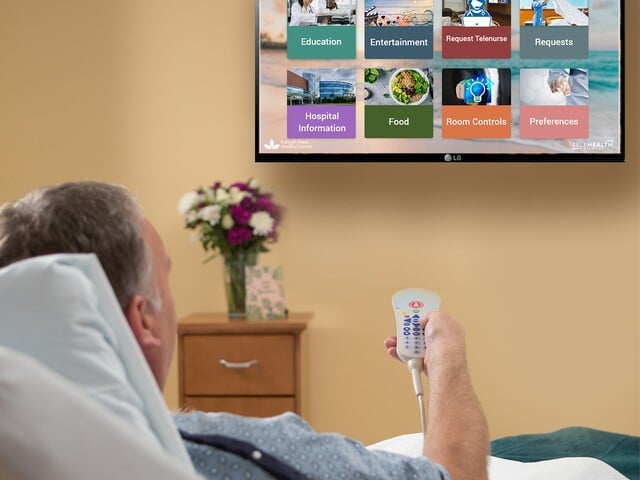
In many patient rooms, however, patients are asked to interact with unfamiliar tools like pillow speakers or complex menu systems. This can be especially challenging for elderly patients or those with limited mobility.
From the Field – Jeff’s perspective
“Ease of use has to be one of the top priorities. A patient sitting in bed is often using a device that isn’t intuitive to them, like a pillow speaker, instead of the remote they’re used to at home.”
Patient Experience, Safety, and HCAHPS Impact
The patient room experience directly influences satisfaction scores and operational outcomes. When patients struggle to access entertainment, education, or communication tools, it increases frustration and leads to more calls for assistance.
In some cases, usability challenges can introduce safety risks if patients attempt to get out of bed to resolve an issue themselves.
From the Field – Jeff’s perspective
“If a patient can’t easily interact with what’s in the room, they may try to get up even when they’ve been told not to. That experience ties directly to HCAHPS scores and how patients evaluate their stay.”
Reframing the Patient Room TV as an Interface
Rather than treating the patient room TV as a single-purpose display, many hospitals are beginning to view it as a central interface for care, education, and communication.
The TV is already present in nearly every patient room. The opportunity lies in how it is integrated with software platforms that support virtual care and patient engagement.
From the Field – Jeff’s Perspective
“Instead of rolling carts into the room, the TV is already there. The question becomes how you use that screen to support virtual care, education, and interaction without adding another device.”
Virtual Care and Workflow Efficiency
Virtual care continues to expand as hospitals address staffing shortages and burnout. When virtual care tools rely on mobile carts or standalone devices, nurses are often responsible for setup and operation.
Integrating virtual care directly through the patient room TV reduces complexity and helps virtual workflows align with existing care processes.
From the Field-Jeff’s Perspective
“Virtual care is becoming critical. But when it requires someone to roll a cart into the room, it defeats the purpose. Using the TV that’s already there makes virtual care easier to scale and easier for staff to support.”
Moving Toward Integrated Ecosystems
Healthcare organizations are increasingly reassessing legacy environments made up of disconnected technologies. Rather than adding new point solutions, the focus is shifting toward integration and interoperability.
Integrated, software-driven ecosystems help reduce support issues, simplify workflows, and create more consistent experiences for patients and staff.
From the Field-Jeff’s Perspective
“The real opportunity is moving away from individual products and toward systems that work together. When technology operates as a single ecosystem, it removes friction instead of creating it.”
Conclusion
The evolution of patient room technology reflects years of incremental decision-making driven by immediate needs. While that approach delivered progress, it also introduced complexity that many hospitals are now working to address.
By rethinking the patient room TV as part of an integrated ecosystem, healthcare organizations can reduce support burdens, improve usability, and better align technology with clinical workflows. The goal is not more technology, but technology that works together in a way that supports care delivery rather than competing with it.
About the Author
Jeff Nicoll is the Director of Sales at Avidex, where he leads go-to-market efforts around the Avidex healthcare solutions portfolio and the national healthcare sales organization. Jeff leverages over 15 years of sales leadership and strategic growth, and has held executive sales leadership roles at organizations such as SMART Technologies and ScanSource, prior to joining Avidex. Jeff works with healthcare and enterprise customers to ensure Avidex solutions solve the complex challenges many face with the ever changing technology landscape.