

 Jeff Nicoll
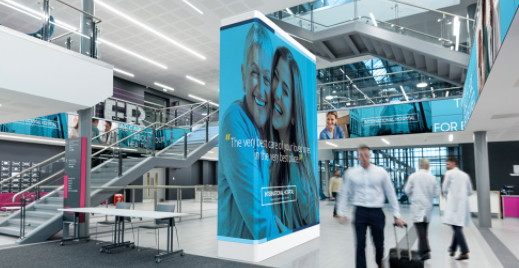
Healthcare IT strategy has historically focused on Electronic Medical Records (EMR), cybersecurity, and core clinical systems. While those areas remain foundational, audiovisual (AV) technology is increasingly being considered as part of broader healthcare IT planning.
Modern AV systems now support clinical workflows, staff collaboration, patient engagement, and facility-wide communication. As hospitals look to improve efficiency and experience without adding complexity, AV is being evaluated less as standalone hardware and more as integrated infrastructure.
AV Technology’s Expanding Role in Healthcare Facilities
Audiovisual technology in healthcare has moved beyond basic patient room entertainment and meeting room displays. When designed as part of a connected ecosystem, AV systems support daily operations across patient rooms, public spaces, and staff collaboration areas.
Hospitals are using AV to reduce friction in workflows, improve communication, and deliver more consistent experiences for patients, visitors, and staff.
Jeff’s view from the field
“We tend to focus heavily on the patient experience, which we should, but the visitor and family experience matters too. AV outside the patient room plays a big role in shaping how people feel about a hospital before and after care.”
Visitor and Family Experience as an Operational Consideration
Visitor experience plays a measurable role in how healthcare organizations are perceived, especially in competitive markets. Navigating a hospital campus can be stressful, particularly during emotionally charged situations.
Interactive wayfinding displays, parking guidance, and real-time digital signage help visitors find their destination quickly and reduce confusion. These systems also reduce non-clinical interruptions for staff, allowing teams to remain focused on care delivery.
Jeff’s view from the field
“People have choices. In many markets, there are multiple health systems nearby. Sometimes those choices are influenced by a past visit, whether it was your own appointment or visiting a family member. If it’s hard to navigate or frustrating to be there, people remember that.”
Public-Facing AV for Communication and Engagement
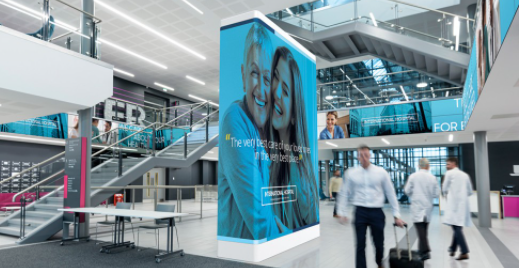
Public-facing AV systems are increasingly used as flexible communication tools. Digital signage and video walls allow hospitals to share information that can be updated dynamically instead of relying on static materials.
Hospitals use these displays to recognize donors, highlight funded initiatives, and communicate timely public health information during flu season or similar events. This enables faster, more consistent communication across public spaces.

Jeff’s view from the field
“We’ve seen hospitals move away from static donor walls toward video walls because donations are often ongoing. Those displays let hospitals tell a fuller story, while also serving as a way to share general information in public areas.”
AV Technology and Care Team Collaboration
AV infrastructure plays a growing role in enabling collaboration among care teams. Training rooms, huddle spaces, and conference areas are now commonly equipped to support hybrid interaction.
Remote collaboration allows specialists to consult without being physically present, helping care teams make informed decisions more quickly and efficiently.
Jeff’s view from the field
“You might have a care team with a very specific patient situation, but the specialist they need isn’t in the building. AV shortens that gap and allows teams across a system, or even across locations, to collaborate and bring the best possible care back to the patient.”
Digital Whiteboards and Nursing Workflow Efficiency
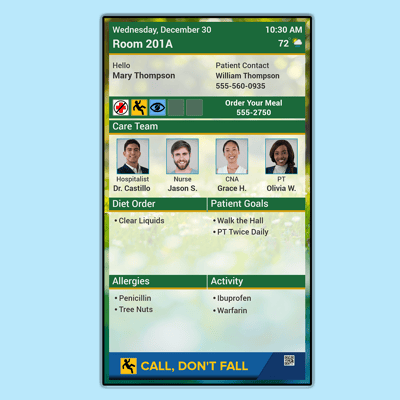
One of the most direct operational benefits of AV technology is its impact on nursing workflows. Manual whiteboards require nurses to repeatedly document information already entered into the EMR.
Digital whiteboards and door signs that integrate directly with clinical systems eliminate that duplication. Patient information updates automatically, reducing manual tasks and saving time across shifts.
Jeff’s view from the field
“Nurses are already putting all that information into the EMR. Asking them to then write the same information on a dry-erase board every shift is just a waste of time. Digital whiteboards fit into their workflow and remove repetitive tasks.”
AV as Part of a Software-Integrated Ecosystem
Healthcare organizations are increasingly evaluating AV technology through a software-first lens. While displays and hardware are necessary, the long-term value of AV systems depends on how well they integrate with clinical platforms, communication tools, and virtual care workflows.
This approach allows hospitals to extend the functionality of existing infrastructure rather than replace it.
Jeff’s view from the field
“The technology that gets adopted fastest is the technology that fits naturally into how people already work. When AV systems integrate with the software hospitals are already using, the impact is immediate.”
Conclusion
Audiovisual technology is becoming a practical component of healthcare IT strategy. When integrated thoughtfully, AV systems support communication, collaboration, and workflow efficiency across the hospital environment.
Rather than operating as isolated tools, modern AV solutions increasingly function as part of connected ecosystems that help technology work more smoothly for patients, visitors, and staff alike.
About the Author
Jeff Nicoll is the Director of Sales at Avidex, where he leads go-to-market efforts around the Avidex healthcare solutions portfolio and the national healthcare sales organization. Jeff leverages over 15 years of sales leadership and strategic growth, and has held executive sales leadership roles at organizations such as SMART Technologies and ScanSource, prior to joining Avidex. Jeff works with healthcare and enterprise customers to ensure Avidex solutions solve the complex challenges many face with the ever changing technology landscape.